Shake Me Up Before You Go, Beautiful Snow Globes
The snow globe: an emblem of winter, a cherished childhood trinket, a gift-shop staple. It’s an object that simultaneously evokes holiday cheer and, for some, eye-roll-worthy kitsch. Snow globes are irresistible for their promise of brief, easy entertainment—plus the added visual delight of the whimsical miniatures found inside.
You place the dome in your hand, turn it over and beautifully, magically the New York skyline, or your favorite Disney character or the Golden Buddha is engulfed in a swirling slow-motion blizzard. Everyone can relate to them – evoking a childhood memory or nostalgia of a simpler time. For the moments that the snow descends, we’ve created a whole new landscape where everything is quiet and all you can do is watch the flitter-fall.
Yet despite their ubiquity, most of us don’t know where snow globes come from. Indeed, the early years are rather fuzzy—but it is clear that the snow globe traces back to Europe near the end of the 19th century.
Snowdomes, snowglobes, paperweights, snow machine, snow shakers, snow scene, water domes, water balls, dream globes, blizzard weights or dream balls were likely derived from heavy glass paper weights which were popular in the latter part of the 1800’s. The glass paperweights were made from costly materials which made the popular item inaccessible to the general public. Not only were snow globes less expensive, they engaged the viewer. Snow globes are dynamic — creating a miniature snow storm descending on the encased diorama.
The first mention of a snow globe featured a man with an umbrella displayed at the Paris Exposition of 1878. Eleven years later at the 1889 Exposition, visitors came to marvel at the steel structure of the Eiffel Tower. There are no examples remaining of these first souvenir globes – but others introduced later suggest that domes were created to commemorate the inauguration of the Tower. The concept quickly became popular throughout Victorian Europe featuring religious themes and pilgrimage sites.
A few years later, a Viennese man Edwin Perzy developed the same idea when researching a way to improve operating room lights. A glass globe filled with water creates a magnifying lens by increasing refraction. To enhance the reflected light, Perzy put ground glass in the water. When it quickly sank, he tried semolina which floated slowly to the bottom of the globe. It did nothing to improve the light quality, but the snowfall inspired him to make his first snow globe: a reproduction of a Viennese shrine in a glass bulb with water, magnesium powder and rock. The snow domes were exquisitely and painstakingly produced and are still in production today where they make around 200,000 a year outside of Vienna.
Gradually, news of the whimsical trinket reached America. In 1927, a man from Pittsburgh named Joseph Garaja applied for the first snow globe patent there, and with it, he introduced a radical new method: underwater assembly. This ensured that each globe would be fully filled with liquid and saved a significant amount of time and money—transforming the snow globe from an expensive indulgence into the affordable commodity we know today.
Within a few years, snow globes were being sold for as little as $1 (around $100 today) at concession stands across America, and before long, they reached Hollywood. The 1940 Oscar-nominated drama Kitty Foyle, which used one as a plot device to trigger flashback scenes, contributed to a 200-percent increase in sales, according to collectors and authors Connie Moore and Harry Rinker. And in 1941, the Orson Welles epic Citizen Kane featured a snow globe, too—made by none other than Erwin Perzy—in its now-legendary opening sequence, wherein Charles Kane dies while holding a glass sphere containing a wintery miniature log cabin, which falls and shatters on the ground.
By the middle of the century, snow globes had become an American phenomenon. Brands employed them for advertising, and they were even used to promote civilian morale during World War II, with tiny soldiers becoming common additions. Innovations in plastic production and injection-molding during the 1950s further improved the snow globe—pricey particles used for the “snow” were replaced with cheap plastic “flitter,” while glycol mixed with water helped it fall more slowly. The product could be found in gift shops across the country, becoming a highly sought-after souvenir during the post-war tourism boom; Walt Disney’s earliest-known snow globe, one with a miniature Bambi, dates to 1959.
Traditional snow globes have largely remained the same since then, though most are now made of Plexiglas and produced in foreign countries. Still, there’s a big market for high-quality, hand-crafted glass globes: The Viennese Perzy family continues to produce thousands each year, with clients including former U.S. presidents Bill Clinton, who had confetti-filled globes at one of his inauguration parties, and Barack Obama, who once gifted an original Austrian snow globe to his daughters.
In modern culture, snow globes often symbolize childhood, innocence, or so-called “happy days”. However, they are also sometimes used, with dark humor, to evoke more gruesome scenes.
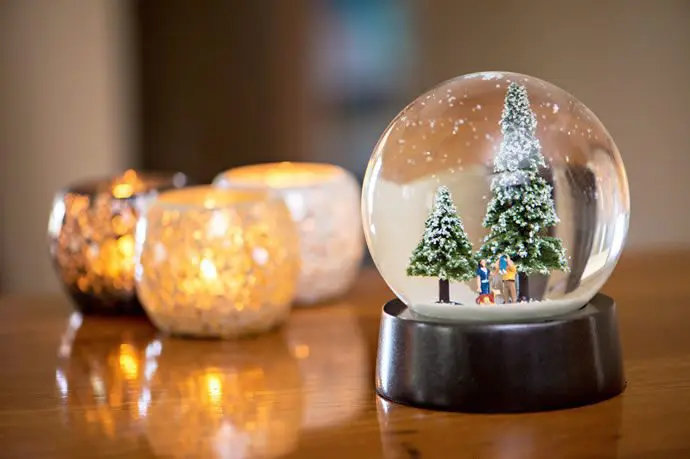
A snow globe (also called a waterglobe, snowstorm,[1] or snowdome) is a transparent sphere, traditionally made of glass, enclosing a miniaturized scene of some sort, often together with a model of a town, landscape or figure. The sphere also encloses the water in the globe; the water serves as the medium through which the “snow” falls. To activate the snow, the globe is shaken to churn up the white particles. The globe is then placed back in its position and the flakes fall down slowly through the water. Snow globes sometimes have a built-in music box that plays a song. Some snow globes have a design around the outer base for decoration. Snow globes are often used as a collectible item.
I remember a snow globe my mother had when I was a child. It was given to her the 1st Christmas she was with my Dad. It was about 6 inches tall and had a house with a snowman in front of the house. It was on a wood color plastic base. I would shake that globe for hours and watch it snow while I daydream. That snow globe and I went on many adventures and faraway places.